|
Day 10 -
Vic arranged for a couple of vans to take us into Siena for the day. |
|
|
History of Siena - (from The Rough Guide, Tuscany & Umbria, 1998)
Though myth attributes its origin to Senius and Acius, sons of Remus
(hence the she-wolf emblem of the city), Siena was in fact founded by the
Etruscans and refounded as a Roman colony -Saena Julia - by Augustus. Over the
course of the next millennium it grew to be n independent republic, and in the
thirteenth and fourteenth centuries was one of the major cities of Europe. It
was virtually the size of Paris, controlled most of southern Tuscany and its
flourishing wool industry, dominated the trade routes from France to
Rome, and maintained Italy's richest banks. The city also developed a highly
sophisticated civic life, with its own written constitution and a
quasi-democratic council - the commune-responsible for as wide a range of
duties as any modern city. It was in this great period that the city was
shaped - and in which most of its art and monuments are rooted.
This golden era, when the
Republic of Siena controlled a great area of central and southern Tuscany,
reached an apotheosis with the defeat of a much superior Florentine army at
the Battle of Montaperti in 1260. Although the result was reversed nine years
later, shifting the fulcrum of political power towards Florence, Siena's
merchants and middle classes embarked upon unrivalled urban development. From
1287 to 1355 the city underwrote first the completion of the duomo and
then the Campo, with its exuberant Palazzo Pubblico. Sienese
bankers spread their operations throughout Europe and the city was at the
forefront of Italian art.
The prosperity and innovation
came to an abrupt halt with the Black Death, which reached Siena in May 1348.
By October, when the disease had run its course, the population had dropped
from 100,000 to 30,000. The city was never fully to recover. The population
today is around 60,000.
The city today - Siena's swift
decline from republican capital to little more than a market centre explains
the city's astonishing state of medieval preservation. Little was built and
still less demolished, while allotments an vineyards occupied the spaces
between the ancient quarters, as they do today. Its near pristine state is
also a result of escaping war damage in 1944 and 1945.
Since the last war, however,
Siena has again become prosperous, partly due to tourism, partly to the
resurgence of the Monte dei Paschi di Siena. This bank is one of the major
players in Italian finance.
|
|
| |
|
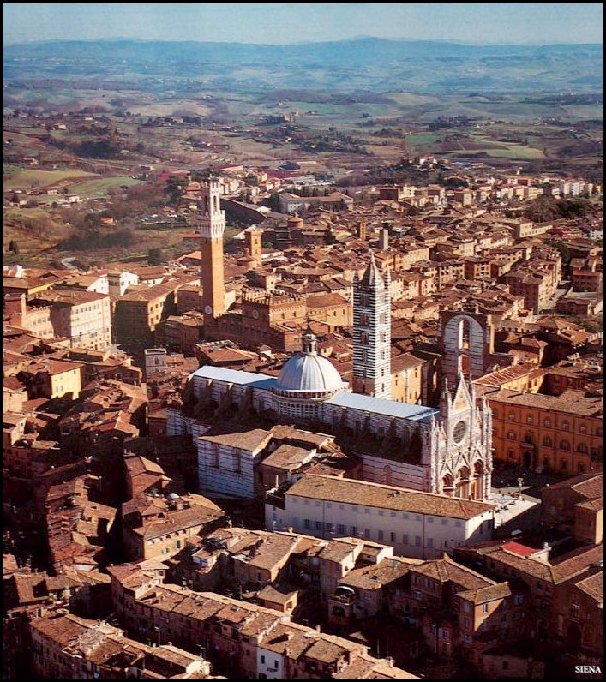
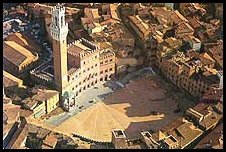
Aerial view of Siena. |
|
 |
|
|
|
|
|
|
|
 |
 |
|
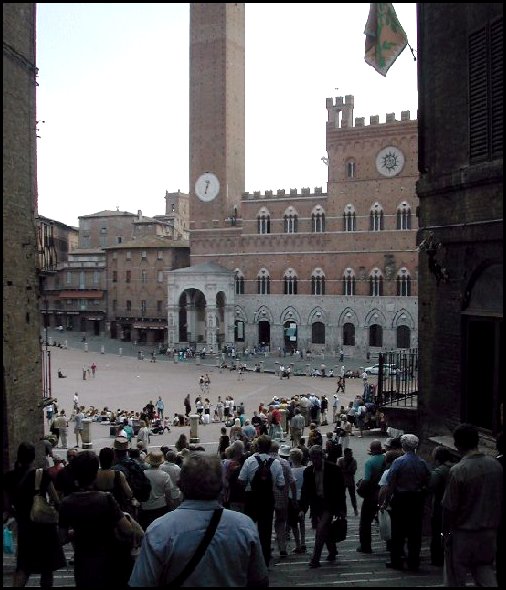
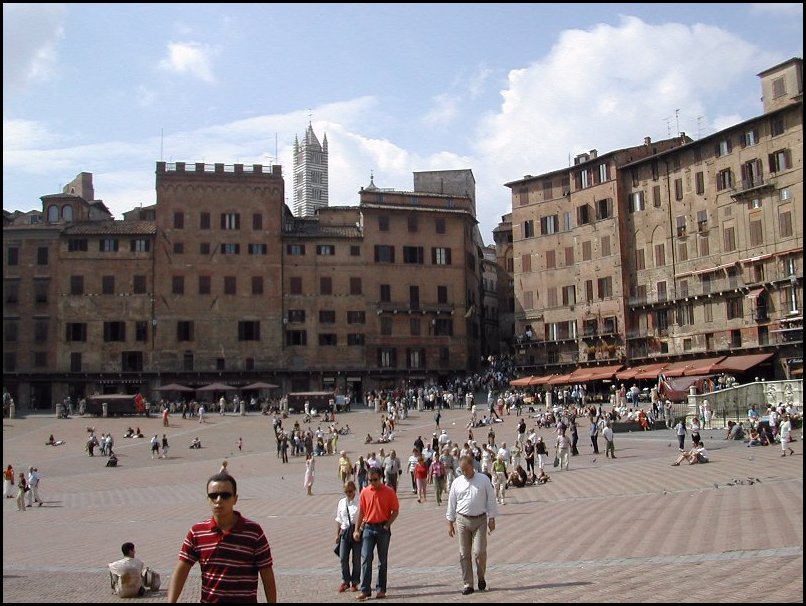
The Campo is the centre of Siena. The Council of
Nine starting buying up land in 1293 in the old market place. To build on
it, it was necessary to construct an enormous buttress beneath the lower
half of the square, where the Palazzo Pubblico was to be raised.
The piazza itself was completed in 1349. The stage-like Campo was from the
start a focus of city life. As well as its role as market place for
livestock and produce it was the scene of executions, bullfights, communal
boxing matches and of course, the Palio. |
|
|
|
|
|
|
|
 |
 |
|
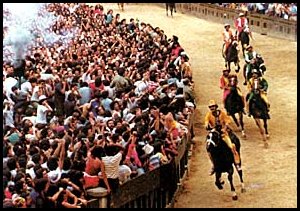
The Palio has been held since at least the
thirteenth century in honour of the Virgin and it remains a living
tradition. Originally the Palio followed a circuit through the town, but
since the sixteenth century it has consisted of three laps of the Campo.
There is only room for ten riders in which participants draw lots both for
the horses and jockeys and starting positions as well. The race becomes a
vehicle for schemes, plots and general mayhem. Follow the link for more
details. |
|
|
|
|
|
|
|
|
 |
|
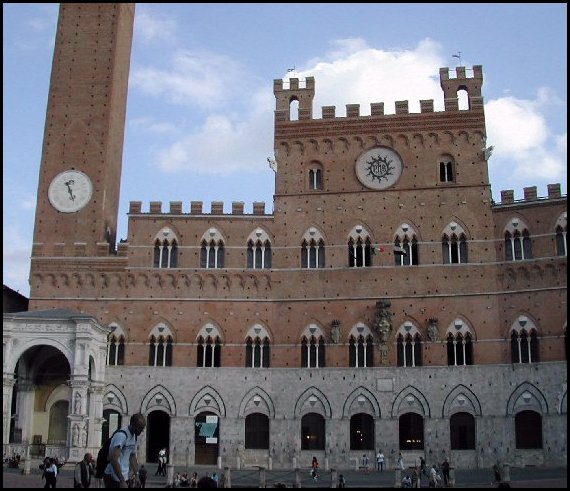
Torre del Mangia
The bell tower, 97 meters, was largely built in the first decade of
the fourteenth century.
The Cappella di Piazza , a stone
loggia set at the base of the tower, which the council vowed to build at
the end of the Black Death in 1348.
Funds were slow to emerge so it wasn't
until 1376 that it was completed. |
|
|
 |
|
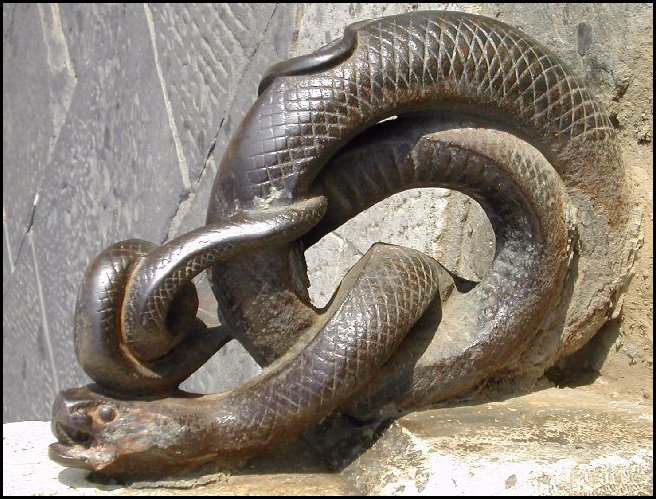
This snake was at the bottom of the concrete posts in front of the
building. |
|
|
|
|
|
|
 |
|
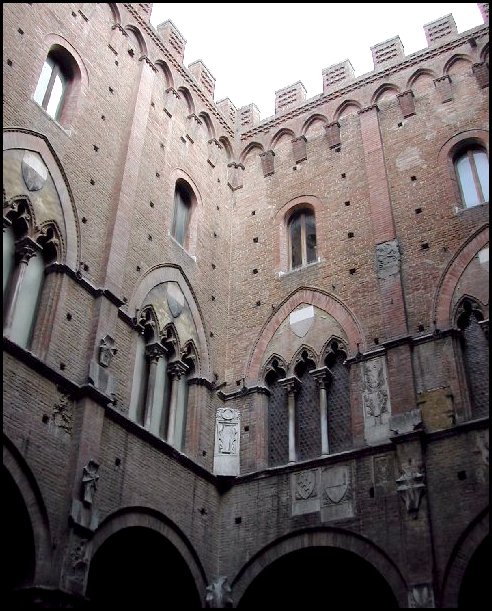
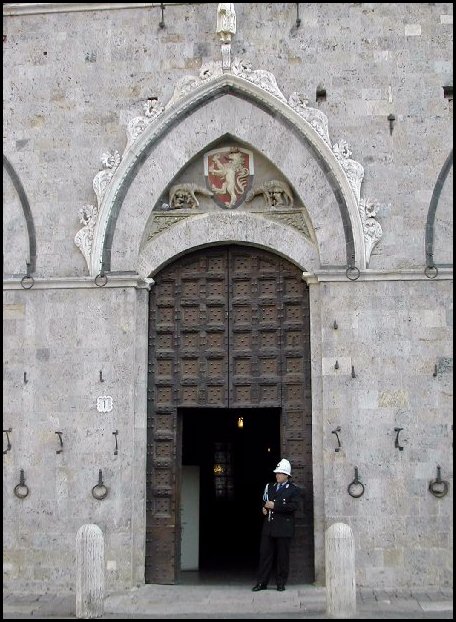
In the days of the comune, the lower floors of the Palazzo Pubblico
housed the city accounts, and the upper storeys, as today, the council. |
|
 |
 |
|
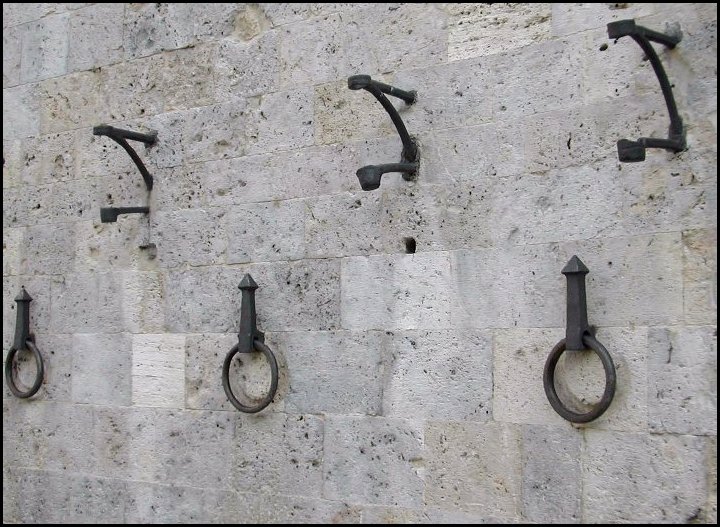
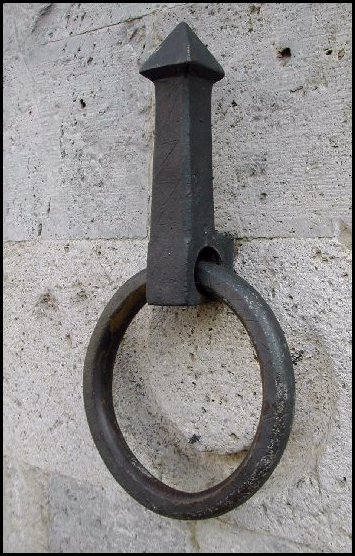
I'm not too sure what these were for but you can see how the concrete
behind the bottom ring has been worn away. |
|
|
|
|
|
|
|
|
 |
|
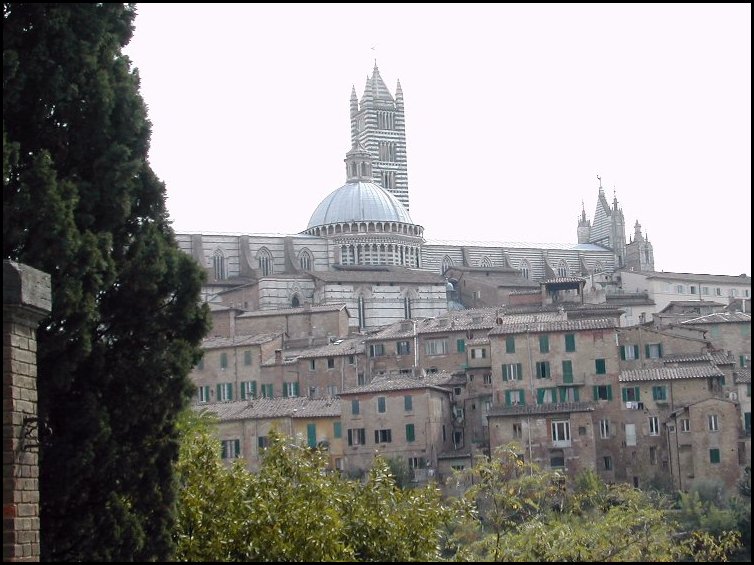
The Duomo seen from a distance. |
|
|
|
|
|
|
|
|
|
 |
|
 |
|
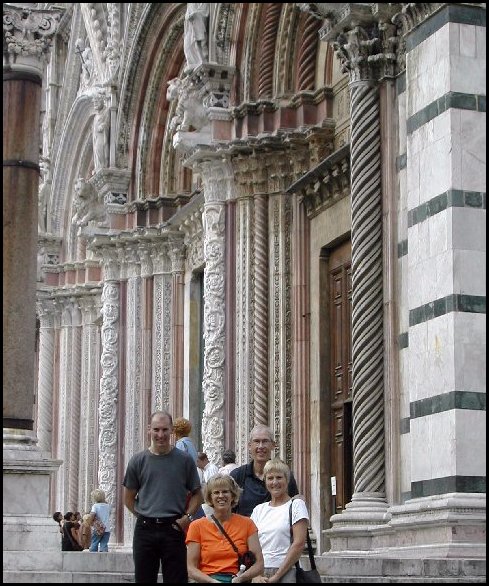
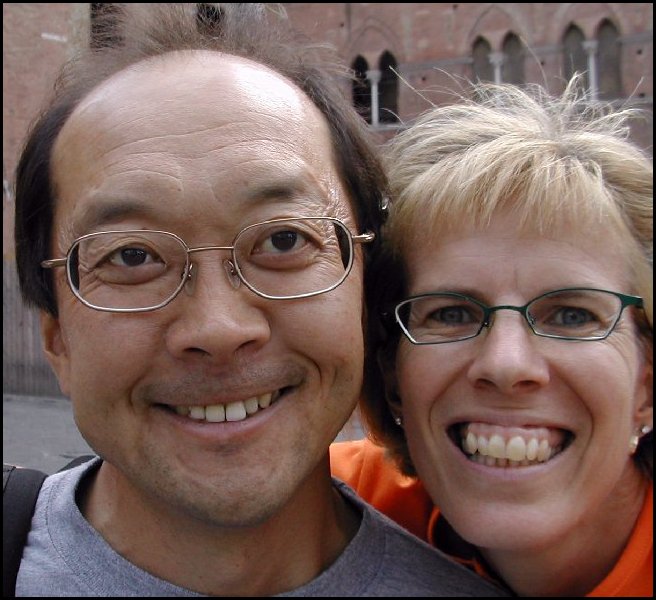
Sherman, who would rather be inside studying the church, had to deal with
this tourist. |
|
|
|
|
|
|
|
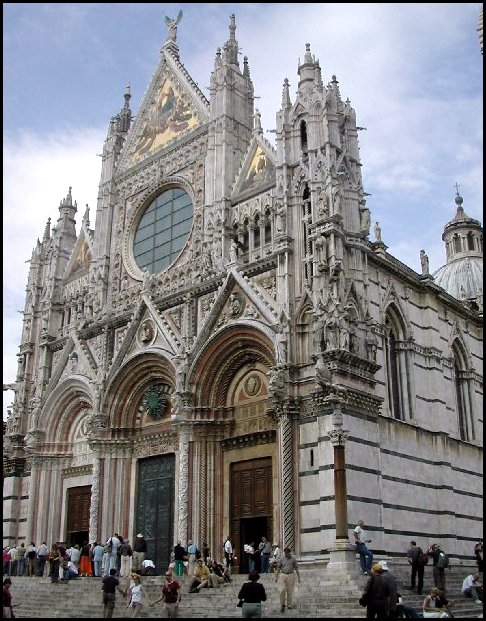
Few buildings reveal so much of a city's history and
aspirations as Siena's Duomo. Complete to virtually its present size
around 1215, it was subjected to constant plans for expansion. An attempt
to double its size ground to a halt as the walls gaped under the pressure.
It's style is an amazing conglomeration of Romanesque and Gothic,
delineated by bands of black and white marble.
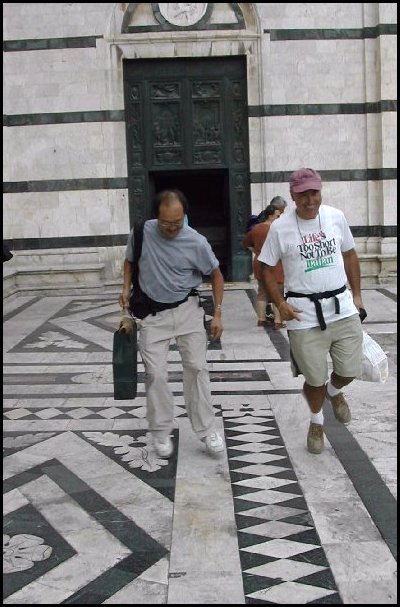
The facade's use of black and white decoration is echoed
by the suomo's great marbel pavement, which begins with geometric patterns
and a few scenes outside the church and takes off into a startling
sequence of fifty-six figurative panels inside. These were completed
between 1349 and 1547, with virtually every artist who worked in the city
trying his hand on a design. This
link
has some great photos of the floor designs and
interior. |
| |
|
|
|
 |
|
Having enough of museums and churches the "boys" play hop-scotch
instead. |
|
|
|
|
|
|
|
 |
 |
|
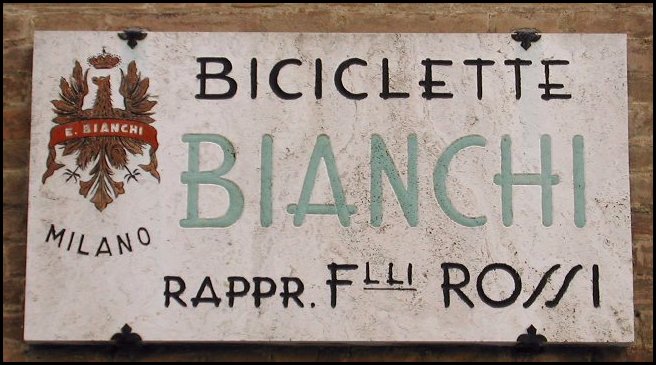
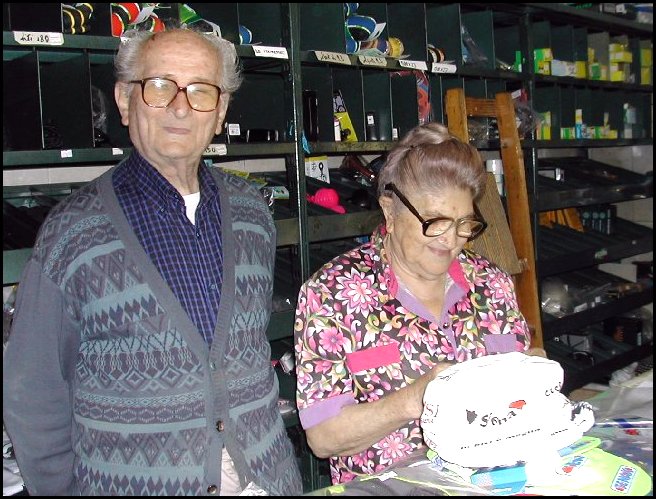
Our first stop in Siena, other than for cappuccino's, was at the local
bike shop. Martini Rossi and his wife still run the store with the help of
(I think) his son. |
|
|
|
|
|
|
 |
|
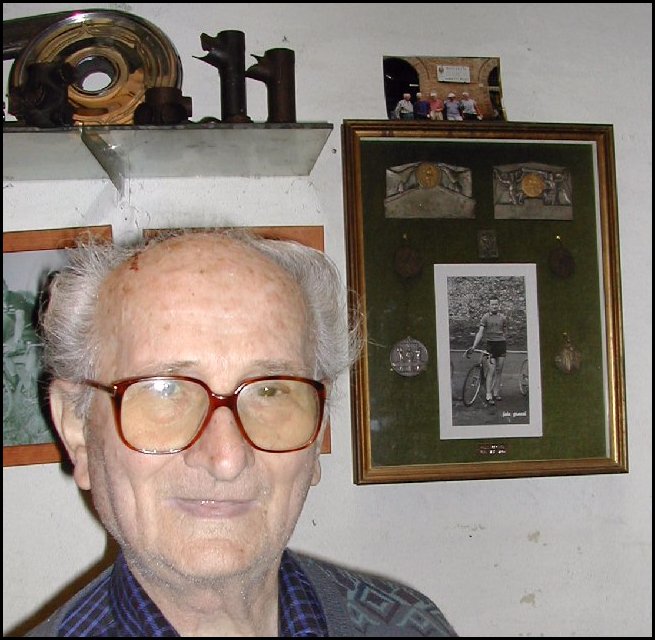
Mr. Rossi with his plaque and medals from former days as a road racer. He
was the provincial champion in 1939. |
|
 |
|
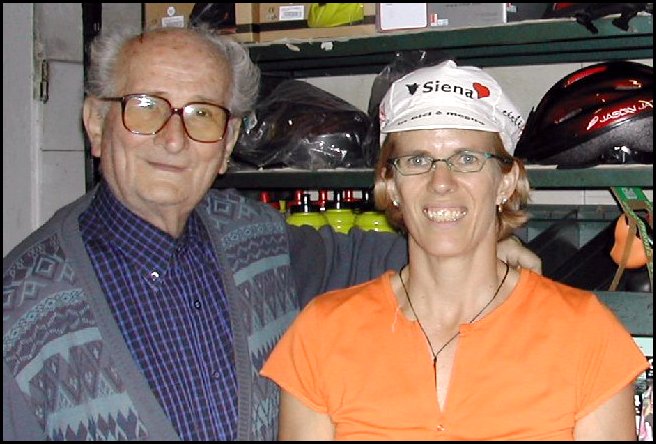
We went back later in the day so Keang could get his bike shirt
autographed and I picked up an autographed cap. |
|
|
| |
| |
|
 |
|
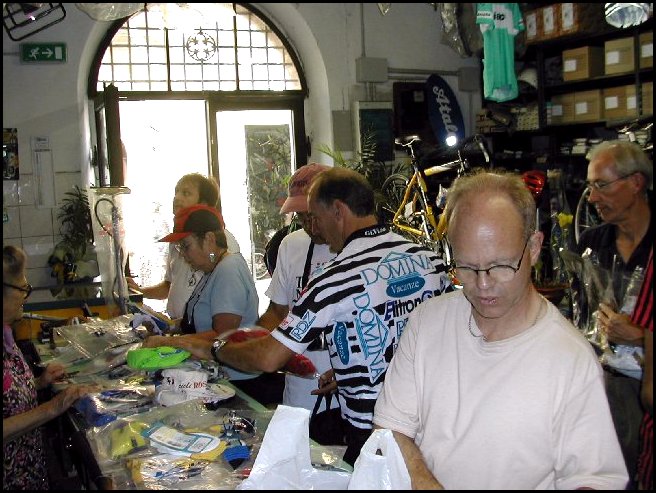
A frenzy of shirt shopping. |
|
 |
|
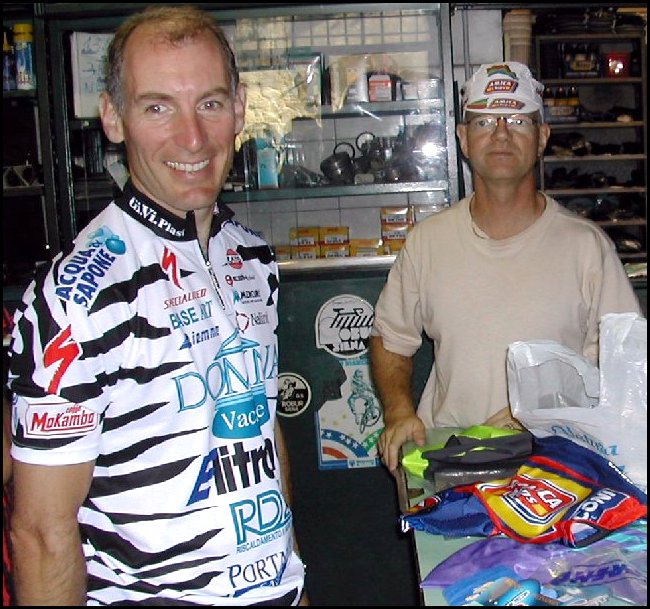
Doug debates which shirt to buy while Roy looks on hoping to scoop the
lime green shirt. Doug choose the Cipollini
in the end. Mario Cipollini won the World Champion race in 2002 so his
shirts were a hot item. |
|
|
|
|
|
|
|
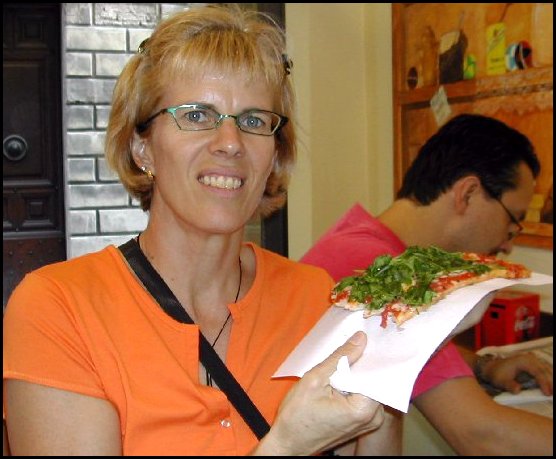
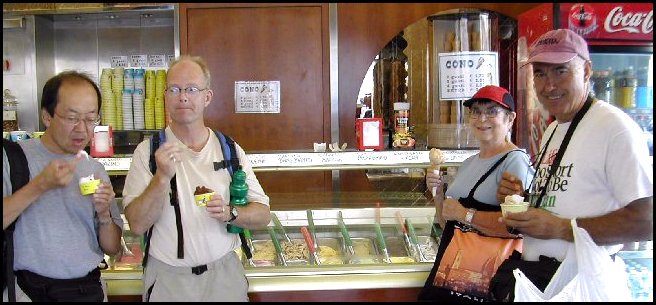
Every good
shopping trip is followed up by a snack. I had one of my very first pieces
of pizza while in Italy and of course there was the mandatory gelato stop. |
| |
|
|
| |
| |
|
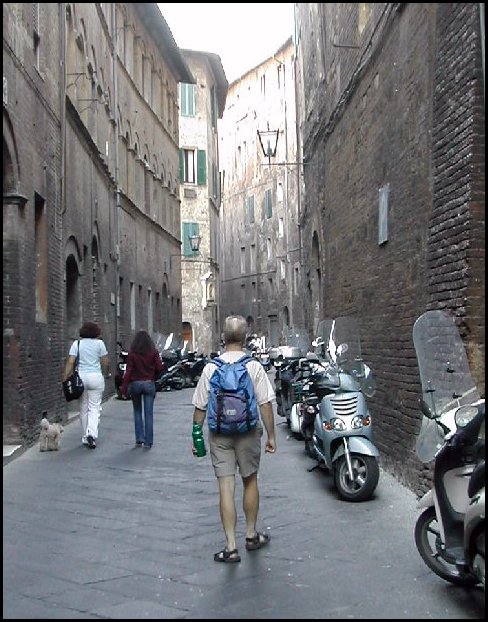
The group
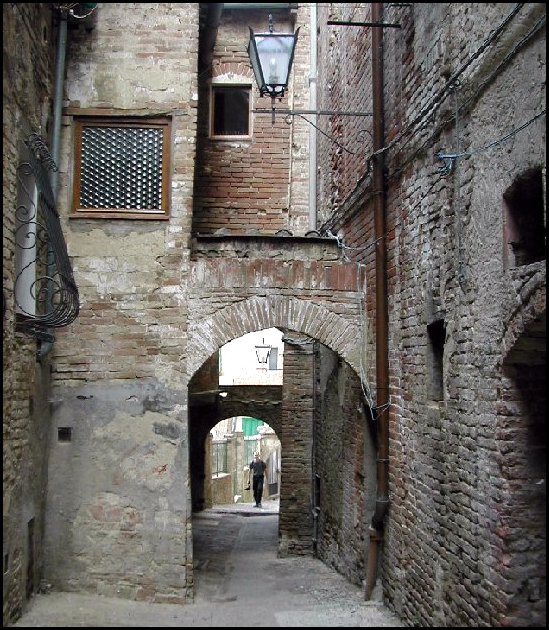
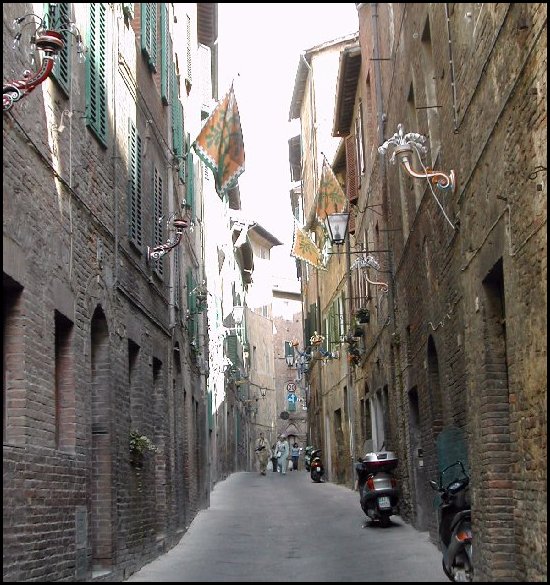
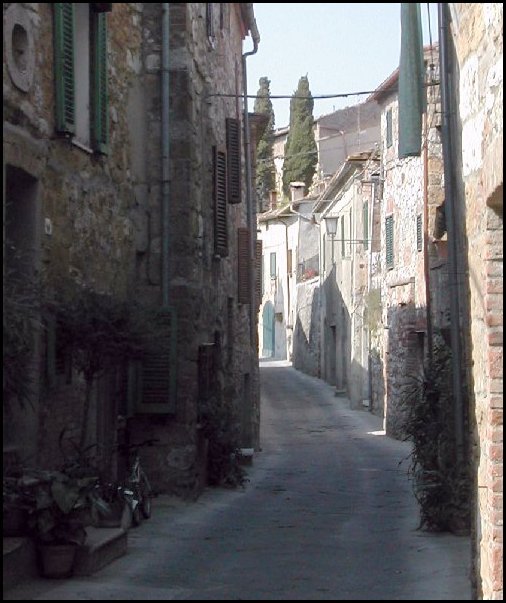
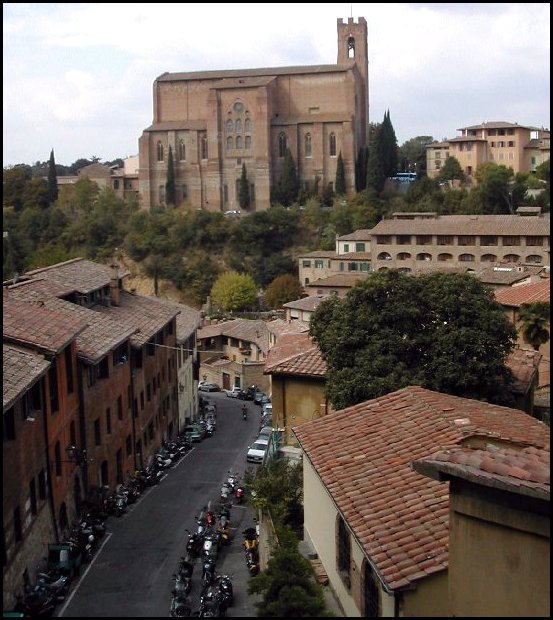
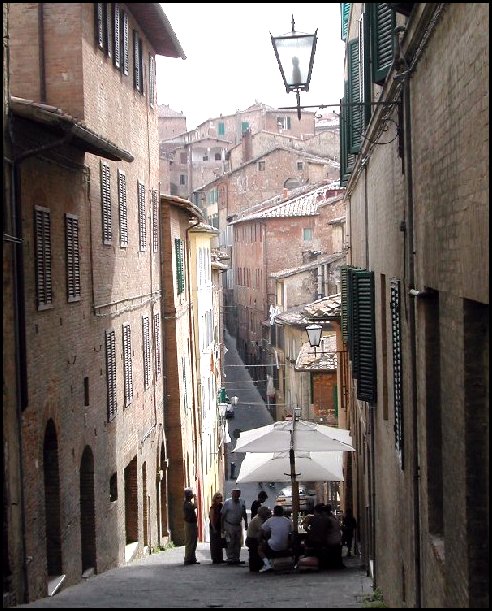
split up after this and Vic, Doug and Carol went in search of San Domenico.
Somewhere we took a wrong turn (we weren't real lost according to Vic) but
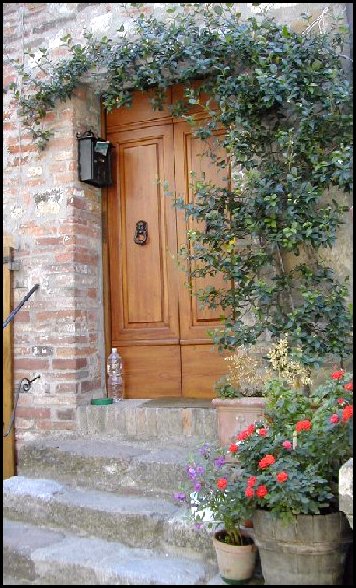
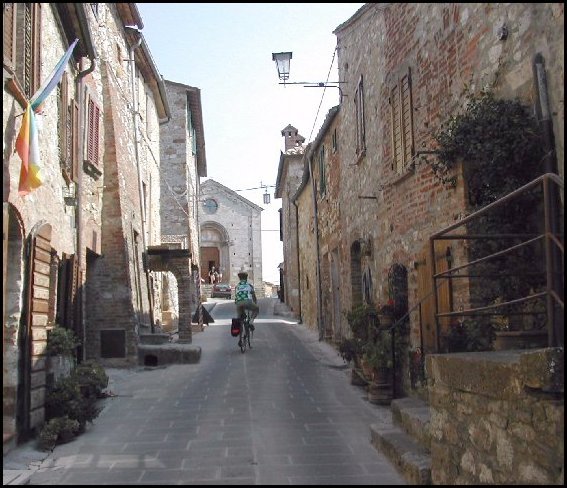
found some interesting streets in the process. |
| |
|
|
| |
| |
|
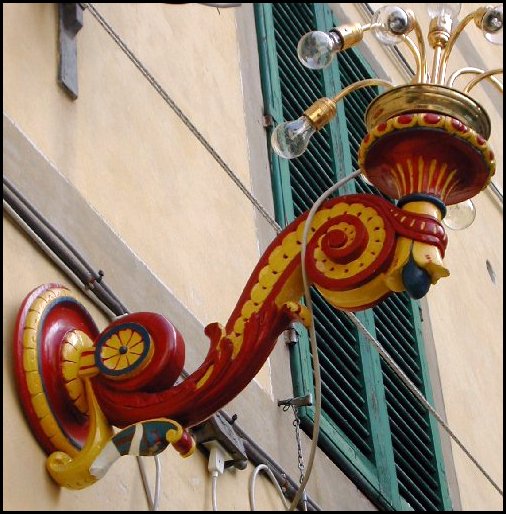
The Contrade Within the fabric of the medieval
city, Siena preserves its ancient division into wards, or contrade.
These are integral to the competition of the Palio and sustain a unique
neighbourhood identity, clearly visible as you wander around the streets.
Each of the seventeen contrade has its own church, social centre and
museum. Each too, has its individual flag and a heraldic animal motif,
after which most of them take their names The animals - caterpillar,
giraffe, snail, goose, porcupine, owl, dragon, Leocorno (imaginary
animal), wolf, ram, shell, wave, panther, forest, turtle, eagle, tower, -
can be seen all around the city on wall plaques and are represented in a
series of modern fountains near the contrada churches or headquarters. |
| |
|
|
| |
| |
|
|
| |
|
|
|
|
|
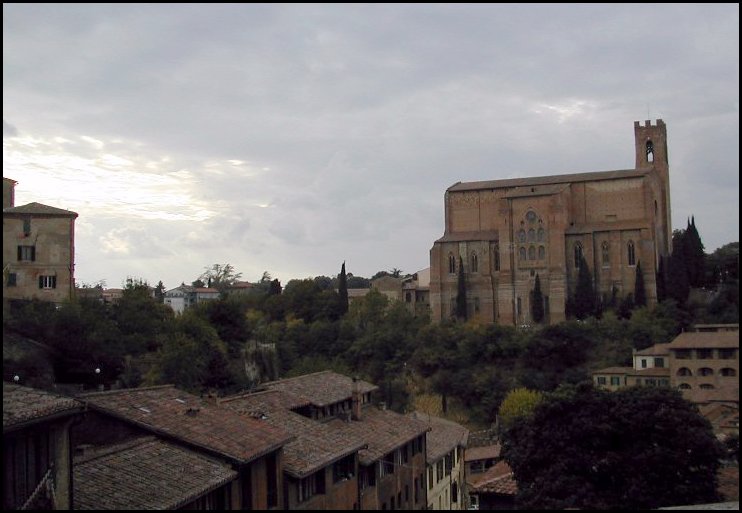
San Domenico The Dominicans founded their monastery
in the city in 1125. Its church is a vast, largely Gothic building,
typical of the austerity of this militaristic order. |
| |
|
|
|
 |
|
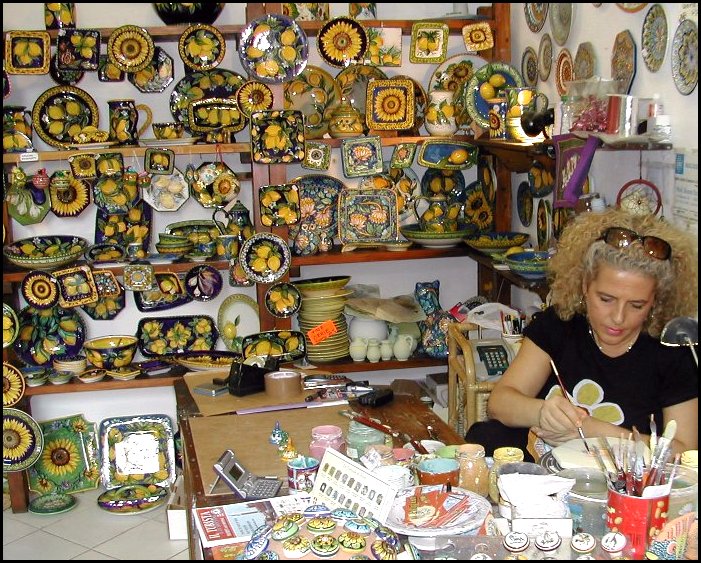
There were lots of pottery shops with the artists painting on site.
Everything came with a price though. |
|
|
| |
|
|
|
 |
|
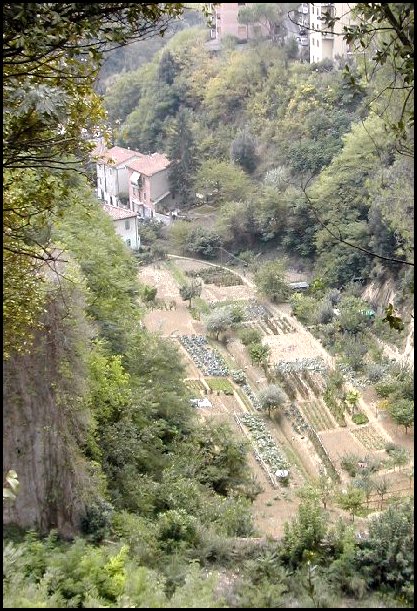
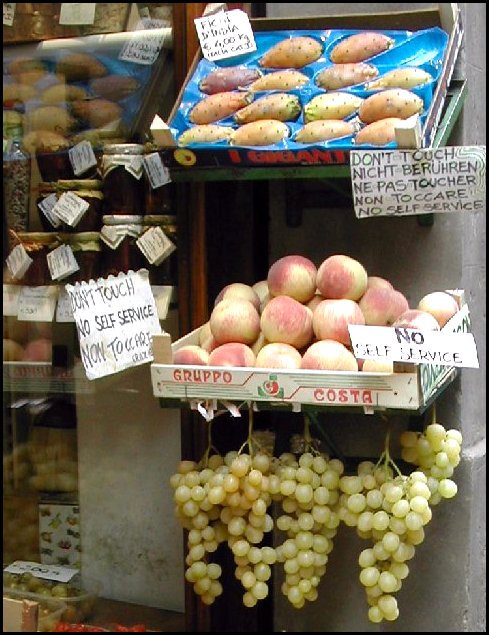
There was a huge garden in the valley between the main town and San
Domenico. |
|
|
 |
|
There were signs in every language telling you not to touch the fruit. AT
least they wouldn't be bruised. |
|
|
| |
| |
|
 |
|
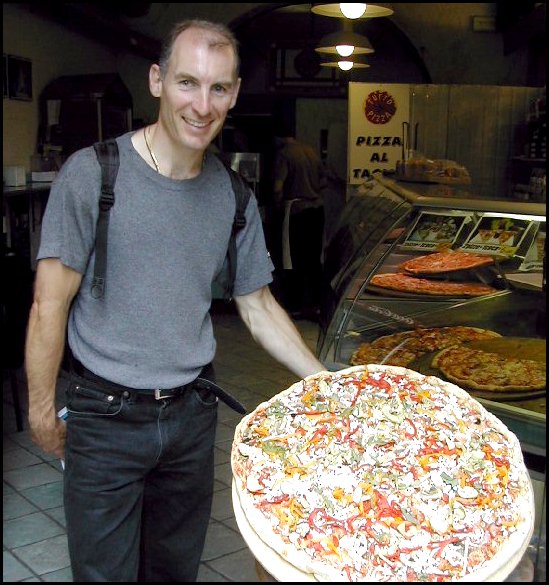
Pizza anyone? |
|
|
 |
|
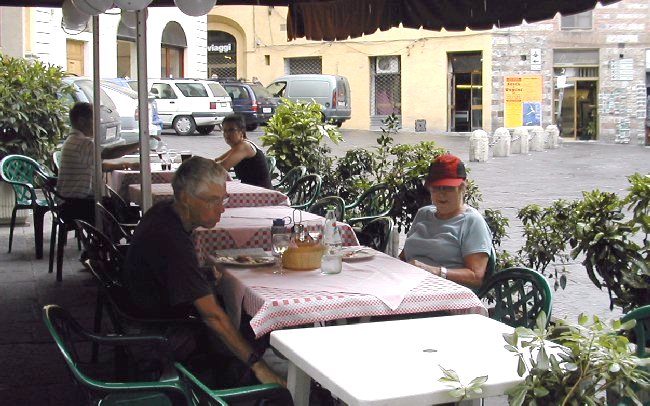
About the time we were getting desperate for some lunch we found Brian and
Myrna enjoying some nice cheeses and wine. |
|
|
| |
|
|
|
|
|
After lunch, Roy and I took a stroll through some of the quieter streets. We
found our way into the university area. |
| |
|
|
| |
| |
|
 |
|
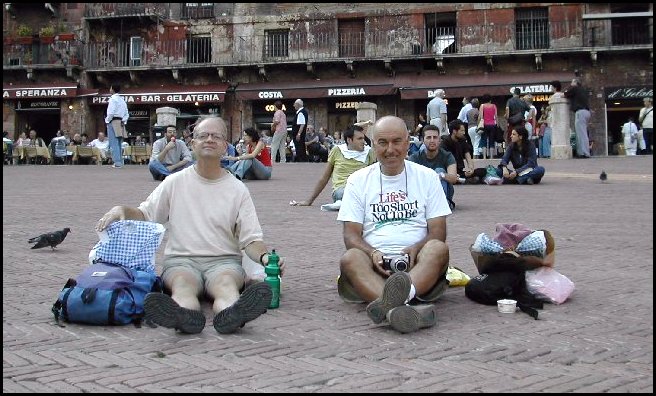
Roy and Vic spent the rest of the afternoon
relaxing in the piazza and taking pictures of the wildlife. |
|
|
|
| |
| |
|
|
| |
|
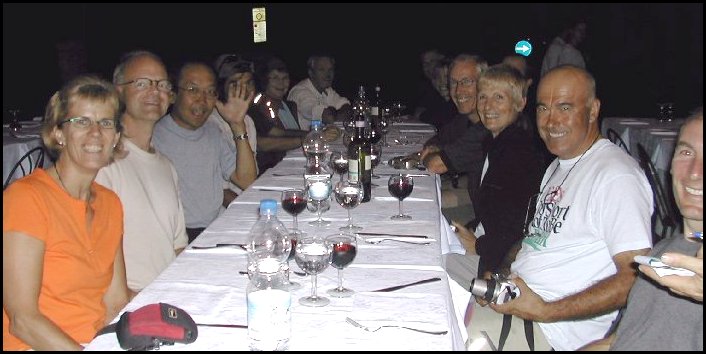
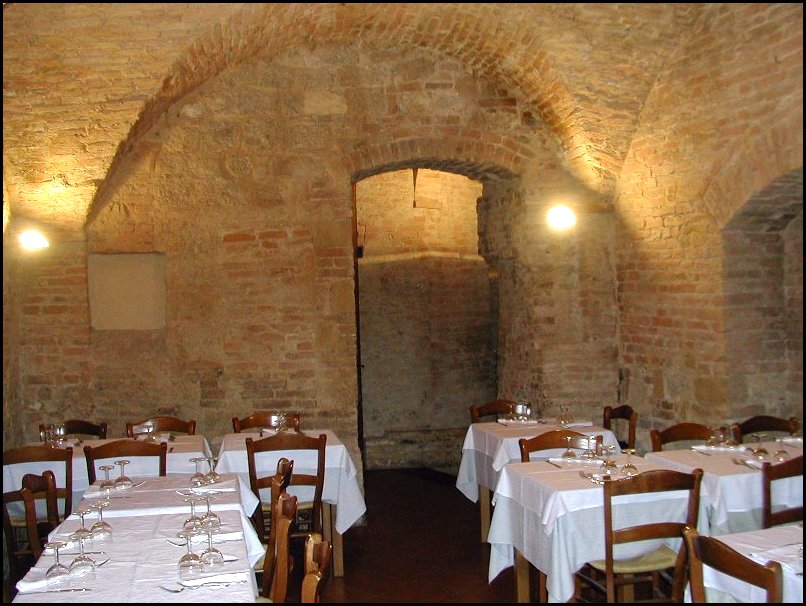
We booked a table right on the edge of the piazza for dinner. It started
to rain a wee bit so they moved us inside. This was one of the original
buildings in Siena. Underneath our table was a drop of about 30 feet down
into some kind of dungeon. |
| |
|
|
|
 |
|
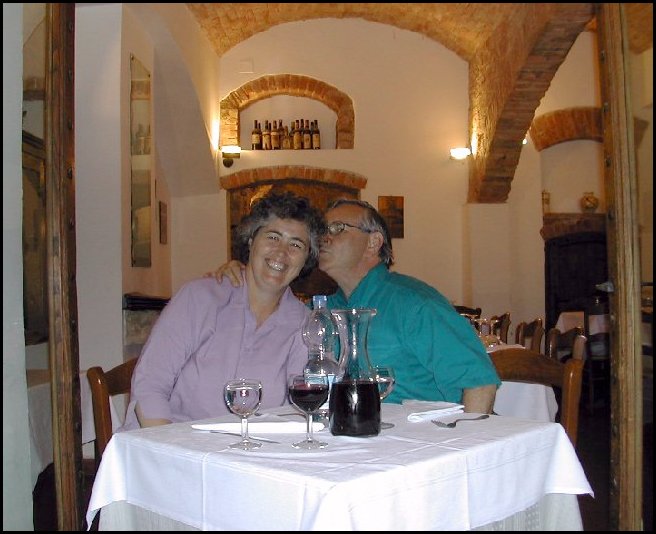
This Australian couple who celebrating their wedding, had the best table in
the house. It was still inside the restaurant, but with a huge open
doorway looking out onto the piazza. |
|
|
| |
| |
|
After a full day in Siena, we were all happy to climb aboard the
vans and head for home. |
| |
| |
|
Shift into gear for
Day 11 |
|
|
|
|
|
|